



Quick Summary
Seismic retrofit of reinforced concrete beam-column joints is a critical step in improving the safety and resilience of existing structures. This study by Moduline Engineering Consultancy explores an innovative strengthening approach for exterior unreinforced RC beam-column joints, helping prevent brittle joint failure and improve structural performance under seismic loading.
This paper forms part of Moduline’s ongoing structural engineering research program, where peer-reviewed findings from our team directly inform our design and retrofit practice.
Abstract
This study presents experimental results from bidirectional cyclic loading tests evaluating the seismic behavior of existing large-scale corner beam–column joints reinforced with plain bars. It simultaneously examines the influence of bar configuration, hook geometry, and slab participation.
The results indicate that the as-built beam–column joint response is primarily governed by joint shear failure combined with beam bar slip. In contrast, the retrofitted specimen is characterized by beam flexural action, column rocking, and bar slip, with only minor internal joint damage.
Introduction
Beam–column joints are critical components of RC moment-resisting frames, particularly under lateral loads such as wind and earthquakes. Past earthquakes and experimental evidence have shown that older, non-seismically detailed frames often experience severe and brittle failures at these joints. Modern seismic codes therefore require minimum transverse reinforcement to prevent joint shear failure and ensure adequate nonlinear capacity. However, many existing buildings were constructed before such provisions, leaving them vulnerable due to deficiencies such as plain round bars, inadequate anchorage, insufficient shear reinforcement, and poor detailing.
Despite ongoing efforts to improve the seismic performance of deficient joints, limited research has addressed their behaviour under realistic bidirectional loading. This study investigates the performance of full-scale 3D exterior corner joints subjected to axial load and bidirectional cyclic displacements. The specimens incorporate key features of older construction, including plain bars, slab participation, transverse beams, and 180° hooks bent both within and away from the joint.
Given that current guidelines recommend limiting shear deformation of exterior joints with plain bars to 0.001 radians, conducting realistic 3D cyclic tests provides essential data for improving assessment methods. A practical retrofitting technique is proposed and evaluated against an as-built reference specimen.
The experimental setup (Fig. 1) includes a 3D hinged column base to simulate an inflection point, with beam ends unrestrained horizontally but vertically supported to accommodate bidirectional loading. Both specimens were tested under an axial load ratio of 0.17 f′c Ag, consistent with the prototype structure.
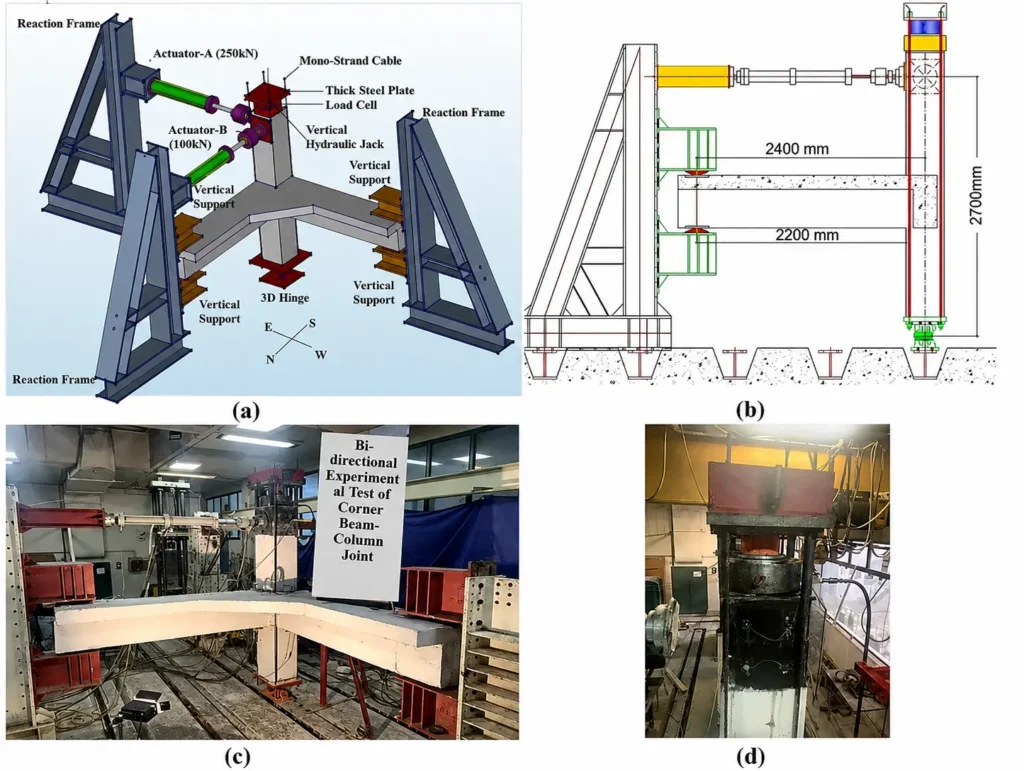
Experimental Results
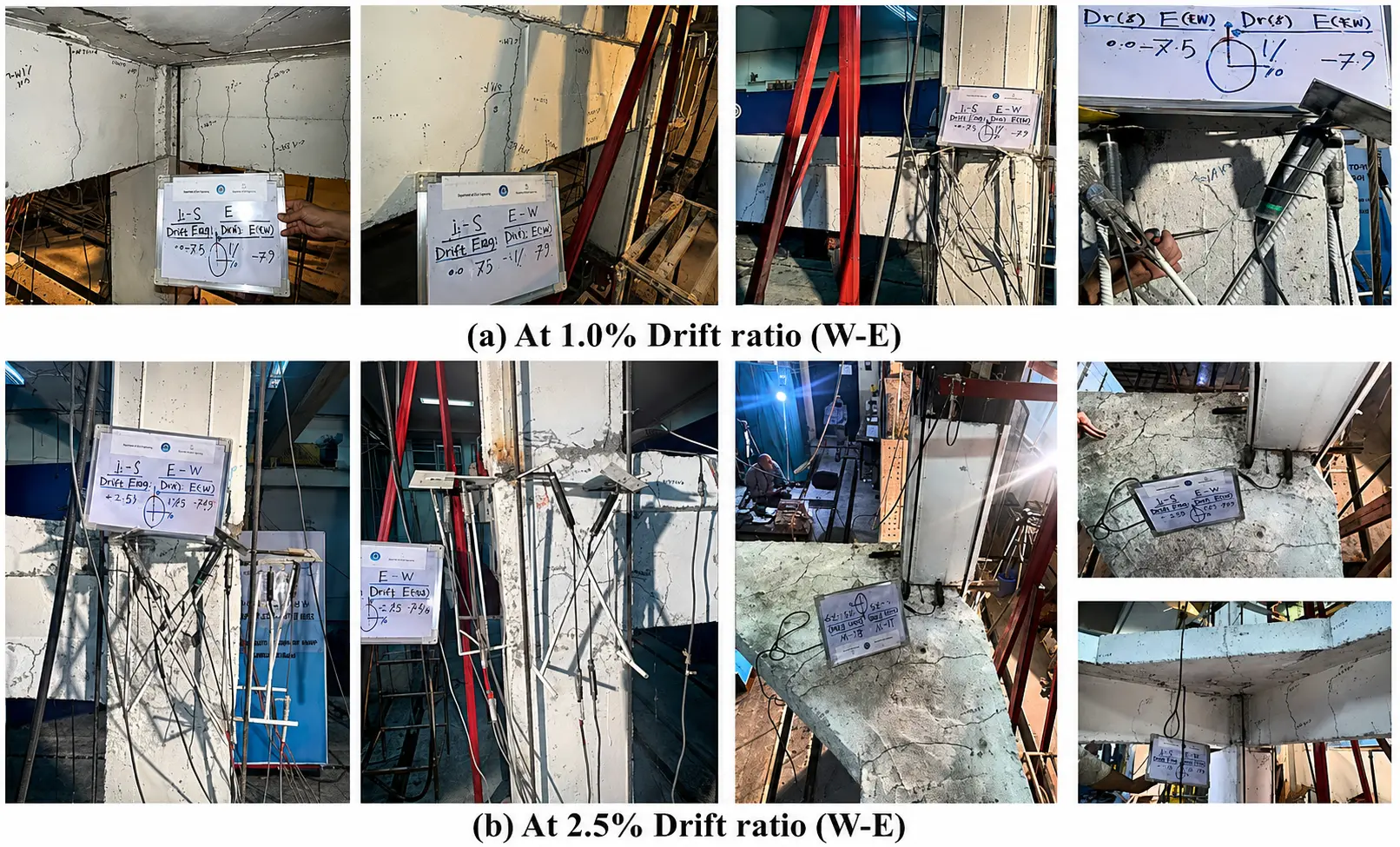
Both specimens—the reference joint (RS) and the retrofitted joint (RETS)—were tested under axial load and bidirectional cyclic displacements. The RS specimen exhibited early flexural cracking in the beams and slab, followed by significant bar-slip-induced cracking at the beam–column interfaces. Joint shear cracking initiated at about 1% drift in the W–E direction and rapidly progressed, leading to widening diagonal cracks, cover spalling, and severe concrete crushing in the joint panel by 2–2.5% drift. The test was terminated once extensive joint damage and crushing at the top-column corner were observed.
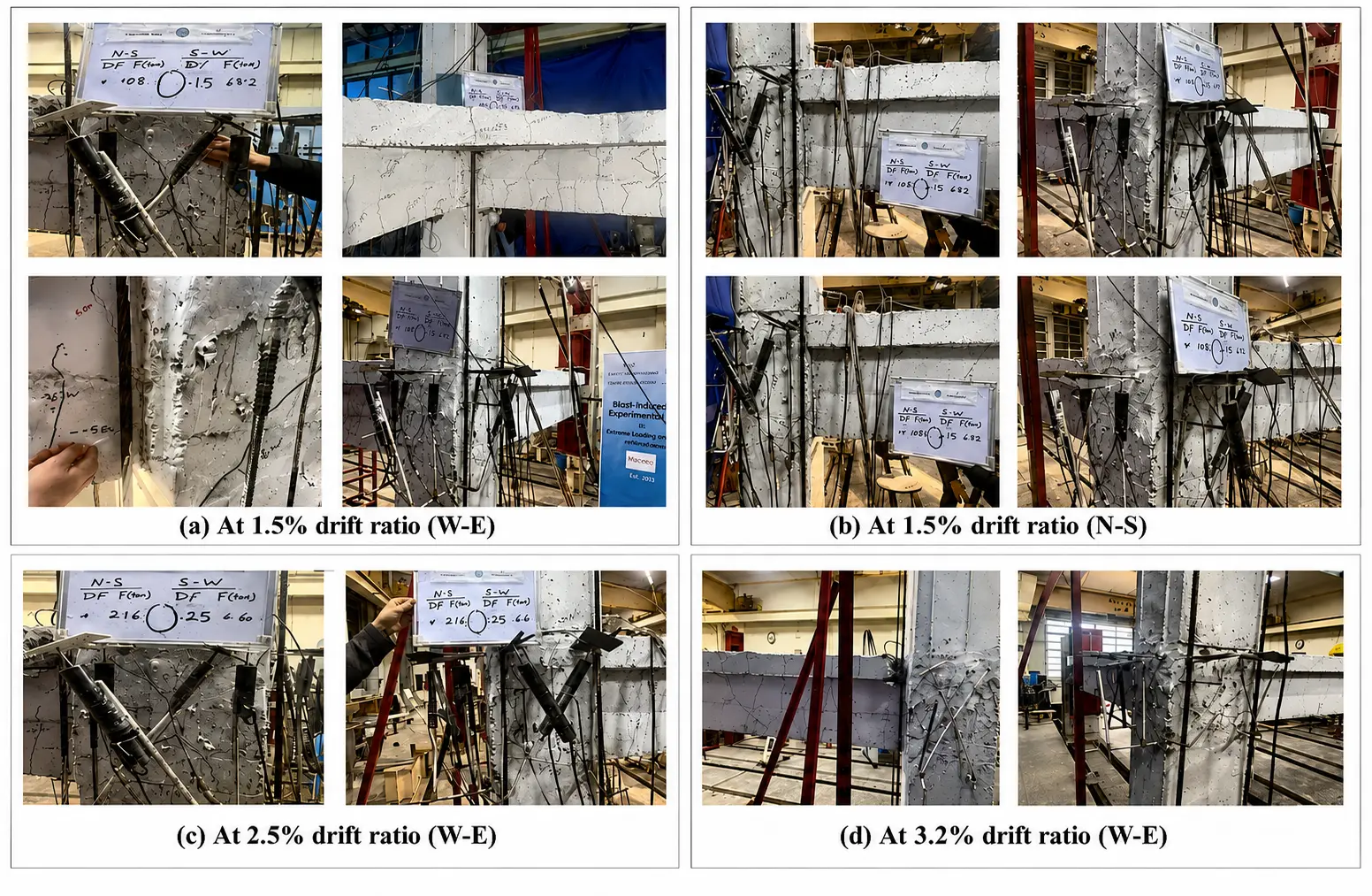
In contrast, the RETS specimen showed delayed and more controlled crack development. Early flexural cracks formed in the beams and slab, but joint shear cracking did not appear until around 1.5% drift due to the added diagonal and horizontal reinforcement. Damage propagated more slowly, with smaller crack widths, reduced bar slip, and limited joint deterioration. Even at higher drift ratios (up to 3.2% W–E), the joint panel exhibited only moderate cracking and minor cover spalling, indicating improved shear resistance. The test ended due to actuator stroke limits rather than specimen failure.
Overall, RS behaviour was governed by joint shear failure and bar slip, while RETS exhibited a combination of flexural action, column rocking, and reduced shear demand on the joint. The retrofitting technique effectively increased joint shear capacity, delayed damage, and prevented premature shear failure. Neither specimen showed concrete wedge expulsion, and the observed failure modes did not align with NZSEE C5 (2018) classifications, largely due to the hook orientation and anchorage configuration.
Hysteresis Response
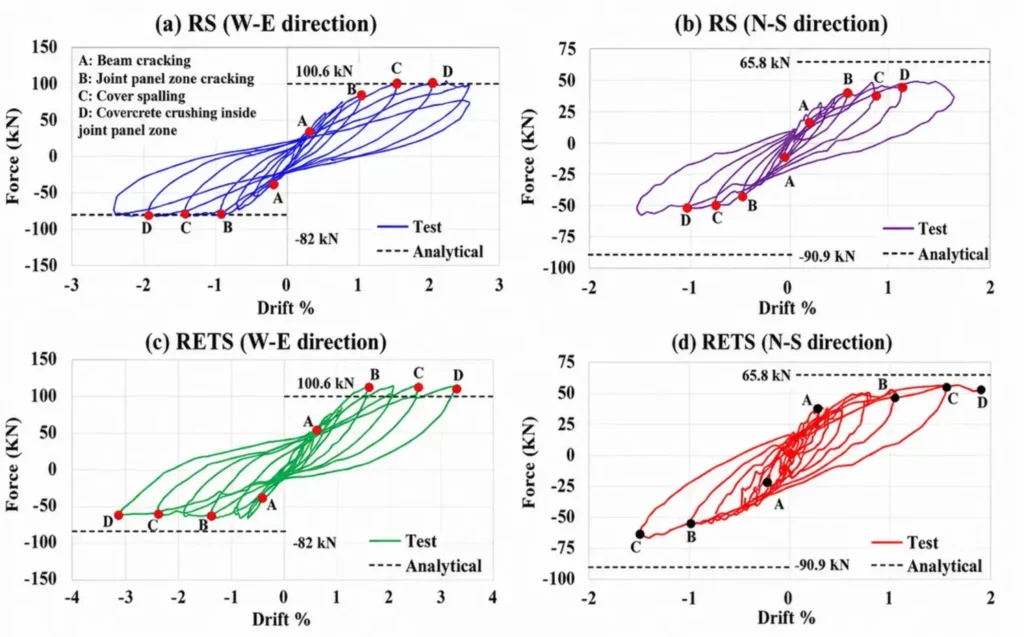
The hysteresis responses of both specimens in the W–E and N–S directions showed stable behaviour, with the retrofitted specimen (RETS) demonstrating superior energy dissipation, larger drift capacity, and reduced pinching compared with the reference specimen (RS). Although both specimens exhibited pinching in the W–E direction due to bar slippage, the RETS curves were noticeably fuller, indicating reduced slip. RETS also achieved higher cracking loads and greater lateral strength at the onset of joint cracking—10% higher in W–E and 20% higher in N–S—compared with RS.
After joint cracking, both specimens showed similar lateral strengths in the W–E direction, while RETS maintained 10–30% higher strength in the N–S direction. RETS also reached significantly larger drift ratios before concrete crushing, with joint cracking delayed by 50–100% relative to RS. Concrete spalling occurred at drift ratios 67% (W–E) and 200% (N–S) higher than those of RS. Overall, RETS achieved a 63% increase in drift capacity in the W–E direction and an 85% increase in the N–S direction. Analytical and engineering methods were used to estimate the lateral strength capacities for both specimens.
Summary and Conclusion
This study tested two full-scale corner beam–column joints under bidirectional cyclic loading: a reference specimen without joint shear reinforcement (RS) and a retrofitted specimen strengthened with planted diagonal and horizontal rebars (RETS). The RS failed mainly by joint shear and bar slip, while the RETS showed delayed damage and improved behaviour due to added reinforcement.
The retrofitted joint demonstrated higher shear strength, significantly larger drift capacity (63% in E–W and 85% in N–S), better energy dissipation, and more stable hysteresis response. RETS also showed earlier and more distributed yielding, greater beam rotation capacity, and higher shear strain capacity compared with RS. Both specimens exceeded NZSEE C5 (2018) shear-capacity predictions, indicating that current code provisions are conservative for bidirectional loading. Overall, the retrofitting technique proved effective in enhancing joint shear performance and delaying damage.
Reference & DOI
To view the full technical study and experimental data, you can visit the official link for searching via Digital Object Identifier (DOI)